
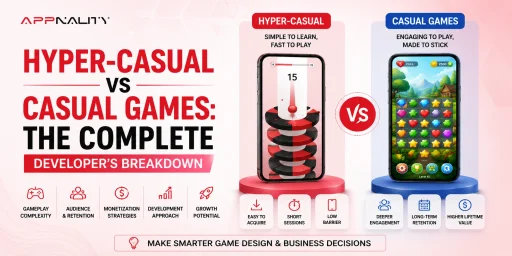
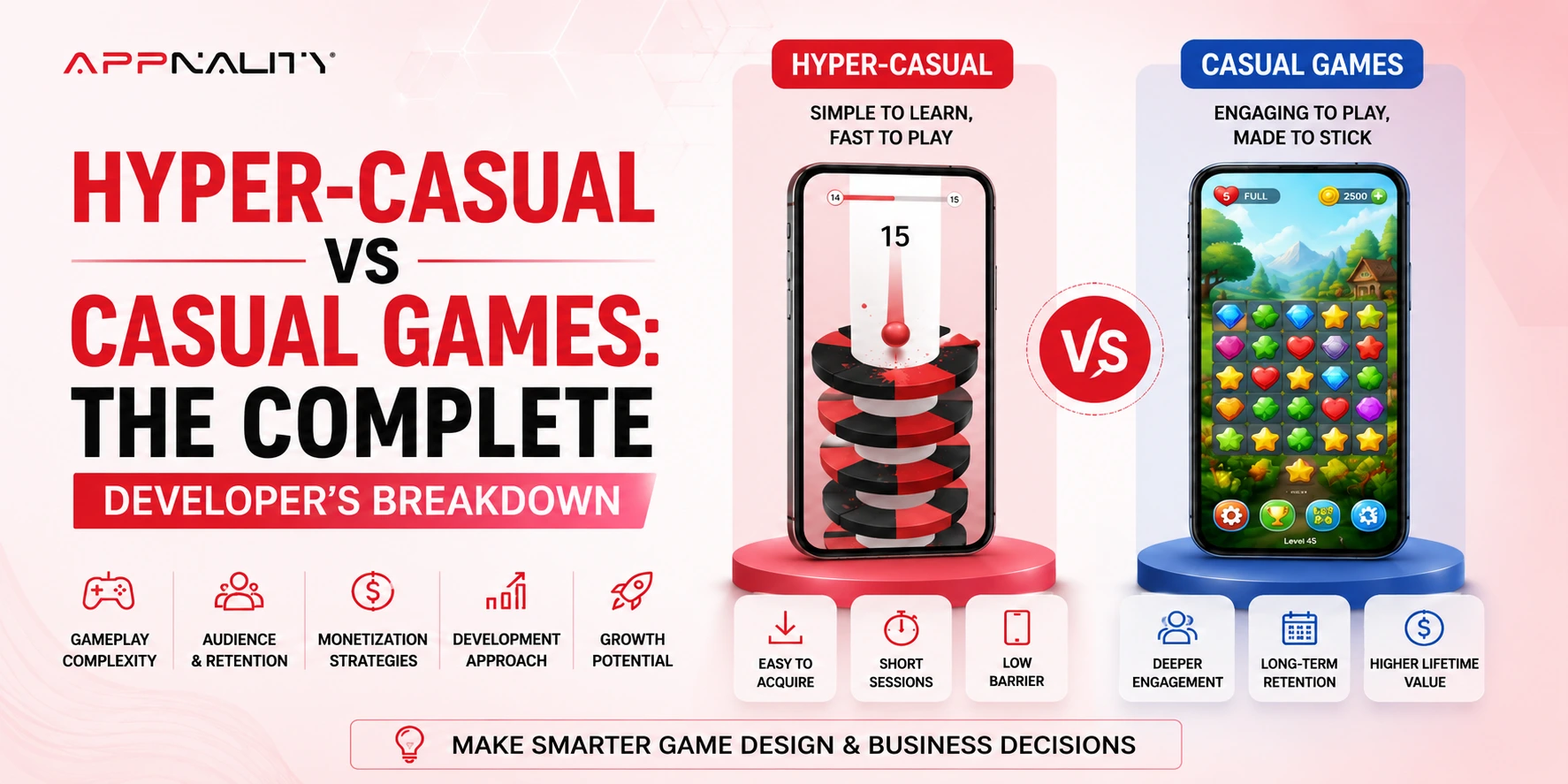

Hyper-casual and casual mobile game development represent two of the most commercially successful categories. While both target accessible, broad audiences, the technical execution, development philosophy, and business models behind these game types differ fundamentally.
We have developed projects across both categories and have seen firsthand how these seemingly similar game types require completely different development approaches, team structures, and go-to-market strategies. The choice between hyper casual game development and casual mobile game development will shape everything from your technology stack to your user acquisition budget.
What is Discussed in this Guide
Before diving into the technical comparison, here is what you will learn.
- Core Structural Differences: Understand the fundamental design, complexity, and engagement differences between hyper-casual and casual games.
- Development Investment Requirements: Learn the realistic time, team size, and budget needed for hyper casual game development versus casual mobile game development.
- Monetization Model Analysis: Discover how hyper casual game monetization differs dramatically from casual game revenue strategies.
- Market Positioning Strategy: Identify which game type aligns with your goals, resources, and target audience.
- Technical Development Insights: Get actionable technical guidance on engines, frameworks, and performance optimization for both game types.
Defining Technical and Design Characteristics
Before comparing the two, we need to establish clear technical definitions. The mobile game industry often conflates these terms, but the differences are significant from a development standpoint.
What Defines Hyper-Casual Games
Hyper-casual games are characterized by extreme simplicity and instant playability. From a technical perspective, they share these core attributes:
- Instant Learning Curve: Players should understand the game within 5-10 seconds using simple tap or swipe controls.
- One Core Mechanic: The entire gameplay revolves around a single polished interaction, making rapid testing and iteration easier.
- Short Play Sessions: Sessions typically last 30 seconds to 3 minutes, requiring fast load times and smooth session handling.
- Minimalist Design: Simple visuals and lightweight audio keep performance optimized across low-end devices while reducing asset costs.
What Defines Casual Games
Casual games occupy a middle ground between hyper-casual simplicity and mid-core complexity. Their technical profile looks quite different:
- Moderate Learning Curve: Some onboarding is needed; players may learn core systems, progression, or strategy through a short tutorial.
- Meta-Progression Systems: Includes unlocks like levels, characters, power-ups, and cosmetics, often requiring persistent data and economy balancing.
- Longer Sessions: Play sessions usually last 5-20 minutes with more intentional engagement and short + long-term goals.
- Higher Production Value: More detailed art, animation, story elements, and audio create a stronger identity and deeper player engagement.
Hyper-Casual Game Development Timeline and Resources
Prototype to Launch: 2 to 6 Weeks
Speed is everything in hyper casual game development. Professionals often operate on a volume model, producing 10 to 20 prototypes to find one that achieves viral metrics. The typical workflow follows this pattern.
A solo developer or a small team of 2 to 3 people generates a concept based on trending mechanics or A/B test insights. Within 3 to 7 days, a playable prototype is built, often using Unity or lightweight frameworks. The prototype is immediately tested with paid user acquisition to measure Day 1 retention and CPI (cost per install).
If metrics hit thresholds like 35% plus Day 1 retention and sub-dollar CPI, the game moves to polish. If not, the project is abandoned.
This rapid iteration model means hyper casual game development is highly metrics-driven. The technical challenge is not complexity but optimization and scalability to handle millions of downloads within weeks.
Team Composition
A typical hyper-casual team includes one to two developers, one game designer focused on mechanic refinement, and one UA (user acquisition) specialist who understands ad networks and analytics. Artists are often contractors or use asset libraries.
Technology Stack
Unity dominates the hyper-casual space due to its lightweight build size and rapid iteration capabilities. Alternative engines like Godot or custom HTML5 frameworks are sometimes used for web-based distribution. If you are looking to build these games efficiently, partnering with experienced mobile game development services can accelerate the prototype-to-market pipeline.
Casual Mobile Game Development Timeline and Resources
Prototype to Launch: 4 to 12 Months
Casual mobile game development requires substantially more upfront investment. The development timeline reflects the need for content depth, polish, and meta-systems.
The pre-production phase alone can take 4 to 8 weeks, involving market research, mechanic validation, and economy design. Core development spans 3 to 6 months, building the game loop, progression systems, and content pipeline. Art and audio production happen in parallel, requiring dedicated resources. A closed beta period of 4 to 8 weeks tests balance, monetization, and live operations.
Team Composition
A casual game typically requires a larger team. This includes 3 to 5 developers covering gameplay, backend, and tools. Two to four artists for 2D/3D assets, UI, and animation. A game designer plus an economy designer for balancing. A product manager to oversee the roadmap and analytics. A QA tester for quality assurance.
Technology Stack
Unity and Unreal Engine are both popular, with Unity having a slight edge for 2D casual games. Backend infrastructure often uses Firebase, PlayFab, or custom server solutions for cloud saves and live events. For games requiring advanced visual effects or 3D environments, people often turn to experts like augmented reality services to create breathtaking game graphics.
Monetization Models: Ad-Driven vs In-App Purchase Strategies
The revenue model is perhaps the most significant strategic difference between these game types. The technical implementation of monetization directly impacts game design, user experience, and long-term profitability.
Hyper Casual Game Monetization
Hyper casual game monetization is almost entirely ad-based. The typical revenue breakdown is 90 to 95 percent from ads and 5 to 10 percent from optional IAP (in-app purchases) like ad removal.
Implementing ad monetization requires precise execution. Interstitial ads appear between sessions, usually after a death or level completion, and must feel smooth rather than intrusive. Rewarded video ads offer rewards like coins or currency in exchange for watching a 15-30 second video, while banner ads generate passive income but need careful placement to avoid disrupting gameplay.
The key challenge is ad mediation and optimization. Hyper-casual games often use platforms like ironSource, AppLovin MAX, or AdMob with waterfall or bidding setups to maximize eCPM (effective cost per thousand impressions). Optimized setups can reach $10-$40 eCPM, with rewarded ads typically outperforming interstitials by 2-3x.
Success depends on maintaining a strong LTV (lifetime value) to CPI ratio. LTV comes from ad impressions per user multiplied by eCPM. When LTV exceeds CPI (e.g., $0.50 vs $0.30), it enables scalable user acquisition via platforms like Facebook, Google, and TikTok.
Casual Game Monetization
Casual games rely primarily on in-app purchases, with ads serving a secondary, complementary role. The revenue split typically looks like 70 to 85 percent from IAP and 15 to 30 percent from rewarded ads.
Building a successful IAP model requires complex technical systems. The game must include virtual currency systems with soft and hard currency, a progression blocker design that creates natural purchase moments without feeling exploitative, and limited-time offers and bundles dynamically personalized based on player behavior.
From a technical standpoint, IAP implementation requires robust receipt validation, server-side transaction logging to prevent fraud, and integration with platform payment systems (Apple App Store, Google Play).
And because casual games monetize through IAP, retention is paramount. A player who churns on Day 3 generates zero revenue. This drives the need for daily login rewards, seasonal events, and content updates. The game must technically support live operations, A/B testing frameworks, and push notification systems.
Understanding how to build apps that retain users long-term is critical, which is why many professionals study the principles of why continuous app optimization matters for retention.
Player Acquisition and Marketing
The user acquisition strategy for these game types differs fundamentally, driven by their respective monetization models.
Hyper-Casual: Volume-Based Growth
Hyper-casual publishers acquire users at a massive scale. A successful game might see 10 to 50 million downloads in its first few months. The focus is on low CPI and broad appeal.
Ad creatives are simple, often showing raw gameplay footage. The goal is to communicate the mechanic instantly. Platforms like TikTok, Snapchat, and programmatic ad networks drive the majority of installs. Organic virality through app store featuring or social sharing provides a bonus but is not the primary growth lever.
From a technical perspective, this requires robust analytics instrumentation to track user cohorts, retention curves, and ad revenue in real time. Attribution platforms like Adjust or AppsFlyer are essential.
Casual Games: Targeted, Retention-Focused Acquisition
Casual games prioritize quality over quantity. While they still acquire millions of users, the focus is on finding players with high LTV potential. Targeting is more sophisticated, using lookalike audiences based on paying users.
Creative testing is extensive, with studios running hundreds of ad variations to identify the highest-converting visuals and messaging. Platforms like Facebook and Google UAC (Universal App Campaigns) dominate, with increasing investment in Apple Search Ads.
Because casual games have higher LTVs (often $2 to $10 or more), they can afford higher CPIs, sometimes $2 to $5 or more in competitive categories. The technical requirement here is deep funnel analytics to understand not just install rates but progression, monetization, and churn at a granular level.
Market Performance and Risk Analysis
Understanding market dynamics helps you assess the risk-reward profile of each game type.
Hyper-Casual Market Dynamics
The hyper-casual market is characterized by extreme hit-driven dynamics. Out of 100 prototypes, perhaps 5 to 10 will be tested with paid UA. Of those, only 1 or 2 will scale profitably. However, when a game hits, it can generate millions in revenue within months.
The market is consolidating around major publishers like Voodoo, Supersonic, and AppLovin, who have proprietary analytics and vast UA budgets. Independent developers increasingly partner with these publishers rather than self-publish.
Casual Game Market Dynamics
The casual market is more stable but also more competitive. Games like Candy Crush, Homescapes, and Gardenscapes have maintained top-grossing positions for years through continuous content updates and live operations.
Breaking into this market requires significant upfront investment but offers more predictable returns if execution is strong. The barrier to entry is high due to production quality expectations and the need for ongoing content.
If you are considering entering the casual space, studying successful models is critical. Resources like mobile game development software can provide insights into the tools professionals use.
Technical Development Considerations for Each Category
Let’s address specific technical challenges and best practices for each game type.
Hyper-Casual Technical Priorities
- Extreme Performance Optimization
Since these games must run on the lowest-end Android devices globally, optimization is critical. This includes minimizing draw calls and keeping frame rates at 60 FPS, reducing APK/IPA size to under 50 MB ideally, and using object pooling to prevent garbage collection spikes.
- A/B Testing Infrastructure
Successful hyper-casual developers test everything, from color schemes to ad placement. Implementing remote config systems like Firebase Remote Config allows real-time changes without app updates.
- Instant Load Times
First-time load must be under 2 seconds. This requires lazy loading of assets, minimizing splash screens, and optimizing initialization scripts.
If you are building hyper-casual games at scale, leveraging hybrid app development services can sometimes provide cross-platform efficiency, though native builds typically remain the gold standard for performance.
Casual Game Technical Priorities
- Scalable Content Pipelines
Casual games require hundreds or thousands of levels. Building an editor or procedural generation system is essential to avoid bottlenecks.
- Robust Backend Infrastructure
Cloud saves, leaderboards, and social features require reliable backend systems. We typically recommend using managed services like Firebase or PlayFab to reduce server maintenance overhead.
- Live Operations Framework
The game must support server-driven events, timed challenges, and content updates without requiring full app releases. This requires a flexible data architecture and CMS (content management system).
Which Path Should You Choose?
The decision between hyper casual game development and casual mobile game development depends on several factors.
|
Choose Hyper-Casual If You: |
Choose Casual If You: |
|
Have a limited budget and a small team |
Have the resources for a longer development cycle |
|
Want to test many ideas quickly |
Want to build a long-term IP and brand |
|
Are comfortable with high failure rates |
Can invest in ongoing content creation |
|
Have strong UA and analytics capabilities |
Have experience with IAP economy design |
|
Prioritize speed over depth |
Prefer fewer, higher-quality releases |
Frequently Asked Questions
Choose the Right Model for Your Goals
The divide between hyper casual game development and casual mobile game development is not just a difference in game design but a fundamental difference in business model, risk tolerance, and technical execution. We have guided you through both paths and can confirm that success in either category requires a clear understanding of the technical, marketing, and monetization infrastructure that supports it.
The principles of effective hyper casual game monetization are as technical as they are strategic, requiring real-time analytics, ad mediation expertise, and rapid iteration capabilities. If you are ready to explore either path with experts who understand both the creative and technical demands, Appnality is here to partner with you from prototype to scale.