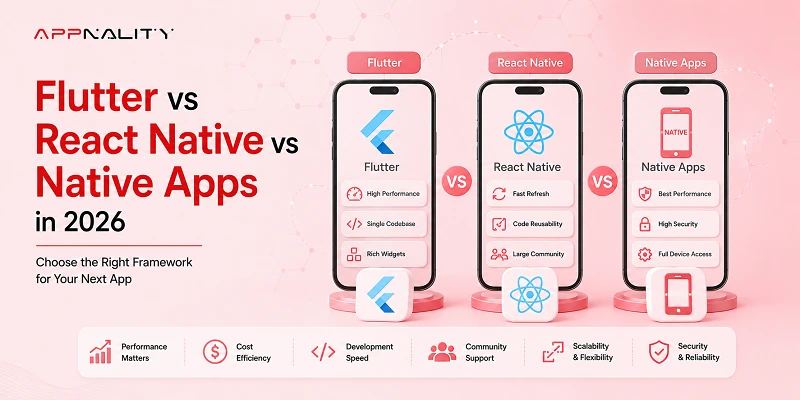

The question of Flutter vs React Native vs native apps has evolved from “which one works” to “which one fits our specific context.” We have built production applications across all three approaches and have witnessed firsthand how the right choice depends on factors far more nuanced than framework popularity or developer preference.
In 2026, the mobile development landscape is no longer a battle of capability gaps but a choice of strategic alignment with your team’s skills, performance requirements, and budget constraints. This guide provides an objective, technically grounded comparison of Flutter vs React Native vs native apps to help you navigate this critical architectural decision in 2026.
Highlights From This Comparison
Before diving into the technical comparison, here is what you will learn.
- Understand how Flutter vs React Native 2026 has evolved with major architectural improvements.
- Learn the key differences in rendering, runtime, and performance across Flutter, React Native, and native apps.
- Discover the right approach based on your team, performance needs, and budget.
- Get honest insights into the native app vs cross-platform development decision.
- Find the best mobile app framework for your project’s specific requirements in 2026.
Core Architecture and Performance Breakdown
Understanding the fundamental comparison of Flutter vs React Native vs native apps is essential before evaluating specific use cases. The architecture determines everything from development workflow to long-term performance characteristics.
|
Decision Factor |
Flutter (2026) |
React Native (2026) |
Native (Swift / Kotlin) |
|
Best Fit |
Visually rich apps and custom interfaces |
Apps that follow native platform design |
Performance-intensive and platform-specific apps |
|
Development Speed |
Fast with a single codebase |
Fast, especially for JavaScript teams |
Slower due to separate iOS and Android development |
|
UI Experience |
Consistent design across all devices |
Looks and feels native on each platform |
Fully optimized for each operating system |
|
Performance |
Excellent for most commercial apps |
Strong for everyday business applications |
Highest possible performance |
|
Access to Device Features |
Wide support through plugins and native APIs |
Extensive ecosystem with native modules |
Immediate access to every platform capability |
|
Maintenance Effort |
One shared codebase reduces maintenance |
Shared codebase with occasional native work |
Two independent codebases require more upkeep |
|
Team Requirements |
Dart developers |
JavaScript or TypeScript developers |
Dedicated Swift and Kotlin expertise |
|
Long-Term Cost |
Lower maintenance costs |
Cost-effective for most products |
Highest development and maintenance investment |
This table reveals that the performance gap between Flutter vs React Native vs native apps has narrowed dramatically, though native still holds the technical edge in raw performance and platform integration depth.
Flutter Continues to Set the Standard for Performance in 2026
Flutter entered its stable production, commanding a significant market share as the best mobile app framework in 2026. The framework’s architecture skips native platform UI components entirely, instead utilizing its Impeller rendering engine to paint every pixel directly onto the screen via GPU acceleration.
The Impeller Revolution
The old complaints about initial animation stutter, known as jank, are completely resolved in the Flutter vs React Native 2026 comparison. Impeller delivers production-ready performance that comfortably drives complex 3D graphics, heavy animations, and particle effects at 120Hz on capable hardware. This rendering engine compiles shaders ahead of time rather than at runtime, eliminating the shader compilation stutters that plagued earlier Flutter versions.
We have deployed Flutter applications with sophisticated custom animations and can confirm that performance is indistinguishable from native implementations for most use cases. The framework’s ability to maintain consistent 60 FPS and even 120 FPS on high-refresh displays makes it viable for gaming, creative tools, and other performance-sensitive applications.
True Multi-Platform Capability
If your product roadmap includes desktop applications for macOS or Windows, embedded devices, or highly customized web applications, Flutter’s unified codebase is unmatched. A single Dart codebase can target iOS, Android, web, Windows, macOS, and Linux with genuinely high code reuse rates approaching 95%. This is a strategic advantage when building ecosystems rather than isolated mobile apps.
For businesses requiring this level of platform coverage, partnering with experienced cross-platform app development services ensures optimal architecture from the start.
The Trade-offs and Limitations
Flutter apps carry their rendering engine in every build, resulting in larger initial file sizes with a minimum of approximately 21MB even for simple applications. While compression and optimization can reduce download size, Flutter apps are typically 30 to 50 percent larger than equivalent native apps.
The programming language Dart has a smaller global talent pool compared to JavaScript or native languages. This creates a hiring bottleneck for some teams, particularly outside major tech hubs. Developers familiar with object-oriented languages can learn Dart quickly, but the ecosystem of Dart-specific tools and libraries remains smaller than JavaScript’s vast ecosystem.
React Native is the Go-to Framework for Enterprise Apps
React Native has successfully stabilized its New Architecture, consisting of Fabric for rendering, TurboModules for native module integration, and JSI (JavaScript Interface) for synchronous communication. The slow asynchronous JavaScript bridge that plagued earlier versions is effectively dead in production applications built with current tooling.
Ecosystem and AI Integration Dominance
Because React Native runs on JavaScript and TypeScript, it integrates seamlessly with the world’s largest development ecosystem. In 2026, where AI features have become critical for competitive applications, nearly every major AI SDK from providers like OpenAI, Anthropic, Cohere, and LangChain ships with JavaScript-first support. This gives React Native a massive deployment speed advantage when integrating cutting-edge AI capabilities.
The Flutter vs React Native 2026 comparison increasingly factors in this ecosystem advantage. While Flutter can integrate these services through HTTP APIs, React Native benefits from official SDKs, type definitions, and community support that accelerate development significantly. Understanding trends from how AI trends are shaping mobile app development highlights why this ecosystem matters.
Tooling Supremacy with Expo
React Native in 2026 is virtually synonymous with Expo, which has become the de facto standard development platform. Expo provides managed workflows that abstract away native configuration complexity, comprehensive development tools, and, critically, EAS (Expo Application Services) for building and deploying applications.
The killer feature is Over-The-Air (OTA) updates. Teams can push JavaScript bundle updates directly to user devices without going through App Store review processes, enabling instant bug fixes and feature rollouts. This capability is transformative for businesses requiring rapid iteration.
The Persistent Challenges
React Native’s reliance on community-maintained native modules remains a double-edged sword. The ecosystem is rich, but dependency management can become complex. Upgrading from one React Native version to another can trigger cascading dependency conflicts requiring careful resolution.
Computationally intensive operations can still bottleneck on the single-threaded JavaScript runtime. While offloading to native modules solves this, it requires writing platform-specific code, reducing the cross-platform advantage. For most business applications, this is not limiting, but for games or real-time processing apps, it is a consideration.
Native Apps Continue to Lead High-Performance Development
Building separate applications using Swift for iOS and Kotlin for Android remains a significant financial investment. The decision to pursue native app vs cross-platform development with full native implementations is increasingly reserved for scenarios where compromise is technically impossible or strategically unacceptable.
Ultimate Hardware and Platform Control
Native development provides unrestricted access to every platform capability, often months before cross-platform frameworks expose them through abstractions. If your application relies heavily on low-level background threads, real-time Bluetooth or hardware communication, advanced system widgets, or cutting-edge platform features like AR glasses integration, native development is mandatory.
We have encountered projects requiring direct access to iOS’s Core Bluetooth stack for medical devices or Android’s background location services for logistics apps where cross-platform frameworks added unacceptable latency or limitations. In these cases, native was the only viable path. For iOS-specific optimization, working with specialized iOS app development services ensures you leverage platform capabilities fully.
Performance Ceiling and Optimization
Native apps achieve the absolute lowest memory footprint, fastest cold-start times, and highest frame rates possible on mobile hardware. For consumer applications where every millisecond of perceived performance matters or for resource-constrained scenarios like background services, native’s efficiency advantage is measurable and meaningful.
Native apps also produce the smallest possible binary sizes. A minimal native app can be under 5MB, while equivalent cross-platform apps start at 15 to 25MB. For markets with limited bandwidth or users on budget devices with constrained storage, this difference impacts download conversion rates.
The Cost Reality
The financial burden of native development is substantial and growing. You must hire, manage, and compensate two separate specialized development teams. This doubles your quality assurance cycles, potentially splits project management, and results in MVP costs that price out most startups and many mid-sized companies.
Feature parity between iOS and Android versions requires careful coordination. Design decisions must account for platform conventions, and bug fixes must be implemented twice. The ongoing maintenance burden is permanent. For businesses evaluating this investment, reviewing the enterprise app development cost guide provides realistic budget expectations.
Which Option Makes the Most Sense for Your App
The Flutter vs React Native vs native apps decision should be driven by a structured evaluation of your specific context across several key dimensions.
Choose Flutter If
Your primary need is absolute UI consistency across iOS and Android with pixel-perfect design control. Flutter’s rendering approach ensures your app looks identical on every device, which is critical for brand-sensitive applications.
You are building applications with heavy custom animations, complex transitions, or creative visual effects. Flutter’s rendering pipeline excels here. Your product roadmap includes desktop applications, embedded screens, or web applications alongside mobile, and you want to maximize code reuse across all platforms.
You prefer a highly predictable, low-maintenance codebase that will remain stable over a 5-10-year lifecycle without frequent dependency churn. You have the capacity to hire or train developers in Dart, or your team has strong object-oriented programming backgrounds that translate well to Dart.
Choose React Native If
Your development team already writes React for web applications, and you want to leverage that existing expertise for mobile development. The learning curve from React web to React Native is the gentlest transition in mobile development.
You are building AI-heavy or data-driven consumer applications that will integrate cutting-edge machine learning services, chatbots, or recommendation engines. The JavaScript ecosystem advantage is decisive here. Hiring speed is a critical bottleneck, and you need access to the largest possible developer talent pool. JavaScript developers outnumber Dart developers significantly.
You require the ability to push rapid Over-The-Air updates to bypass app store review delays for bug fixes or minor feature updates. Your application architecture fits well with component-based UI development, and you value the massive npm ecosystem for third-party libraries.
Choose Native Development If
You are backed by a substantial budget and can afford dedicated iOS and Android teams without compromise. Your application core involves deep technical requirements like complex background processing, advanced hardware integration, real-time system-level operations, or cutting-edge platform features.
You require the absolute smallest possible binary size and fastest cold-start performance, perhaps for emerging markets or resource-constrained scenarios. Your competitive differentiation depends on delivering the most platform-authentic experience possible, adhering perfectly to iOS Human Interface Guidelines and Android Material Design.
You have long-term strategic reasons to maintain complete control over your technology stack without framework dependencies or vendor considerations.
Build Better Apps With a Hybrid Development Strategy
An often-overlooked option in the cross-platform vs native apps debate is the strategic hybrid approach where different parts of your product ecosystem use different technologies based on their specific requirements.
We have successfully guided clients in building their customer-facing consumer app in React Native for speed and ecosystem access while developing their internal admin dashboard in Flutter for desktop compatibility. Another common pattern is building the core app in a cross-platform framework while implementing performance-critical modules like video processing or complex animations as native modules.
This cross-platform vs native apps approach requires more sophisticated architecture and development process management but can deliver optimal results when applied thoughtfully. The key is establishing clear boundaries and ensuring teams have the skills to maintain both codebases effectively.
For complex implementations requiring this level of sophistication, leveraging comprehensive mobile app development services ensures architectural coherence.
FAQs
Choose Based on Context, Not Popularity
The question of which is better, Flutter or React Native, in 2026 has no universal answer because “better” depends entirely on your specific technical requirements. Both frameworks have reached production maturity, which makes them viable for the vast majority of mobile applications. The Flutter vs React Native vs native apps decision should be driven by an honest assessment of your needs rather than framework or industry hype.
We have successfully delivered projects using all three approaches. The best mobile app framework in 2026 for your project is the one that aligns with your strategic context and plays to your team’s strengths. If you need expert guidance navigating this native app vs cross-platform development, Appnality is here to partner with you from architecture through deployment.