
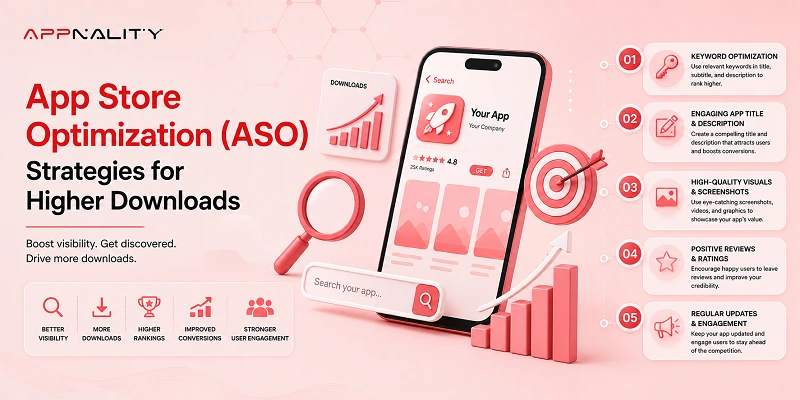

Building a great digital product is meaningless if your target audience cannot find it on their devices. That’s why, to get organic downloads, systematic app store optimization (ASO) is the way ahead.
Search algorithms now care much more about semantic context and user sentiment than basic keyword counts. At Appnality, we believe that sustainable discovery needs consistency between store metadata and actual product value.
So, to keep your software visible, you must design a listing that satisfies both automated store crawlers and real human curiosity.
Key App Store Optimization Insights from Appnality
- Search engines prioritize natural phrasing and contextual user intent.
- Use separate App Store Optimization strategies for the Apple App Store and Google Play.
- High ratings and responsive screenshots convert casual visitors to active users.
- Optimize your title, metadata, and visuals to improve app visibility.
- Track ratings, reviews, retention, and conversions to refine your ASO.
- Localize your listing with region-specific keywords and visuals.
How App Store Search Rankings Work Today
Search algorithms inside mobile marketplaces have changed a lot over the last few years. Traditional keyword matching has been replaced by advanced semantic search engines that analyze user search queries contextually.
This semantic change means that modern ASO strategies in 2026 must align with natural phrasing and everyday human speech. This is why modern app store optimization ASO relies heavily on user intent rather than simple string matching.
Both major application storefronts have integrated neural networks to read descriptions and auto-generate topic tags. For example, when you launch specialized iOS app development services, the system looks beyond your exact metadata fields to understand the broader utility of your software.
If your text copy states that your product resolves high latency in financial trading, the search engine will index you under financial productivity even if those exact words are missing.
|
[User Query: “track daily runs offline”] │ ▼ [Semantic Engine Analyzes Context] │ ▼ [Matches with Latent Concept: “Fitness”, “GPS”, “Offline Data”] │ ▼ [Generates Indexed Results Based on Relevance] |
For instance, Apple Developer Search guidelines show how search results rely on deep text relevance combined with behavioral inputs.
Knowing these updated Apple App Store ranking factors helps you write descriptions that index naturally for long-tail queries without looking like spam. Search results now depend on a balanced mix of download velocity, product stability, metadata relevance, and active user retention.
How to Optimize Your App Listing for More Downloads
Following foundational app listing optimization tips requires a deep understanding of user psychology. Your title and subtitle act as your primary hooks.
Instead of guessing, marketing teams must use modern ASO keyword research tools to extract data. We recommend updating listings with proven app store optimization App Store Optimization techniques, focusing on descriptive terms rather than random phrases. At Appnality, we analyze these updates to help clients maintain peak conversion metrics across all marketplaces.
To maximize initial clicks, your main text fields should deliver immediate value. Users scan listings quickly. If the first two sentences of your description do not address a specific problem, users will tap the back button.
This friction lowers your conversion rates, sending a negative signal to store algorithms. When deploying custom mobile app development services, we structure product copy to put the most compelling features right before the fold.
Best Practices for App Store Metadata
- App Title
Limit to 30 characters, using your highest-weight keyword naturally. - Screenshots
The first three screenshots must convey your core value proposition within two seconds of viewing. - App Icon
Keep designs simple with singular brand focal points to avoid visual noise on high-density displays.
Visual assets are just as critical as your written copy. Your screenshots should display real-time usage scenarios, complete with brief, bold caption texts at the top. If your product features a dark mode or simplified widgets, show those highlights on the very first panel. This visual proof reassures the user that the product fits their current lifestyle.
Apple App Store vs. Google Play Store Ranking Logic
Let us review how Apple App Store ranking factors contrast with Android’s system. While Apple uses a hidden keyword field, Google crawls your entire product description.
When dealing with Google Play ASO optimization, keywords are crawled from your title, short description, and long description up to five times. Knowing these differences is essential because app store optimization ASO requires separate strategies for each operating system.
Google’s search engine uses natural language processing models to read your long description as if it were a standard web page. If you stuff the same keyword into every paragraph, the Play Store algorithm will flag your listing for keyword stuffing and lower your ranking.
If you work on native Android app development services, your marketing copy must distribute variations of your target terms naturally throughout the copy.
| Metadata Field | Apple App Store Requirements | Google Play Store Requirements |
| App Title | Max 30 characters (Indexed) | Max 30 characters (Indexed) |
| Subtitle / Short Description | Subtitle: Max 30 characters (Indexed) | Short Description: Max 80 characters (Indexed) |
| Description | Max 4,000 characters (Not Indexed) | Max 4,000 characters (Indexed up to 5 times) |
| Keyword Field | Max 100 characters (Indexed) | None (Relies entirely on contextual crawling) |
This comparison shows why a single approach fails. If you use a single template, you either miss indexing opportunities on Android or clutter your presentation on iOS. Apple’s system relies on the strict 100-character keyword field. Within that field, write terms separated by commas without spaces, avoiding plurals of words you have already used.
How to Find the Right ASO Keywords
Deploying specialized ASO keyword research tools is the only way to find high-intent terms that drive actual installs. The best ASO keyword research tools now integrate semantic search trend analysis to monitor competitor changes.
So, when building advanced ASO strategies for 2026, teams should focus on relevance, difficulty, and traffic metrics.
Choosing terms based solely on high traffic is a common trap. If a keyword is extremely popular but only loosely related to your product’s actual function, visitors will uninstall the product quickly. We use integrated artificial intelligence services to evaluate keyword alignment, selecting high-intent terms that map to the actual features of your application.
|
[High Traffic + Low Relevance] ➔ High bounces, lower algorithm rankings [Low Traffic + High Relevance] ➔ Steady organic growth, loyal user base [Target Zone] ➔ Medium-to-high traffic with perfect context |
If you construct flexible hybrid app development services, you must ensure that your metadata targets both platform audiences. Integrating these assets acts as one of the most effective app listing optimization tips for software products built on cross-platform frameworks. These metrics represent core Apple App Store ranking factors in the current market dynamics.
ASO Keyword Research Tools Worth Using in 2026
The ASO keyword research tools landscape has matured. The ones producing the most consistent results right now include:
- AppRadar for keyword tracking and competitor gap analysis.
- Sensor Tower for market-level search volume estimates and category benchmarking.
- AppFollow for combining keyword data with review sentiment.
- MobileAction for AI-assisted keyword suggestions and creative intelligence.
Structure Your ASO Keyword Research
To structure your research, follow these three steps:
- Identify Seed Terms
List the exact problems your product solves for users. - Evaluate Search Volume
Track monthly queries to ensure the term attracts sufficient organic traffic. - Assess Competitor Density
Avoid hyper-competitive terms during your initial release phase to allow organic authority to grow.
Ratings, Reviews, and How They Feed the Algorithm
Both app stores use review velocity as an active ranking signal. A steady stream of fresh and positive reviews tells the algorithm that users are currently having a good experience. A large volume of old reviews with nothing recent suggests the opposite.
AI-powered review monitoring tools are making it easier to track sentiment shifts and identify specific pain points before they compound. AI-driven analysis of user feedback can surface patterns that manual review reading would miss entirely, especially for apps generating thousands of reviews per month.
How to Generate More Quality App Reviews
The timing and context of your review prompt matter enormously. Asking immediately after install almost never works. The best-performing prompts appear after a clear moment of user success: a completed task, a milestone reached, a streak maintained.
A few principles worth following:
- Trigger the prompt only after a positive in-app event.
- Keep the ask minimal. Apple’s native SK Store Review Request is the cleanest implementation.
- Respond to negative reviews publicly and promptly. Stores factor response rate into listing quality scores.
- Never incentivize reviews. Both Apple and Google are aggressive about enforcing this, and the penalties are severe.
How Appnality’s ASO Services Increased Organic Downloads
We see this methodology succeed in real-world scenarios. In our detailed multigame case study, our team applied specialized app store optimization ASO methods to a multi-functional entertainment hub. The primary challenge was standing out in a highly saturated gaming market where user acquisition costs were rising rapidly.
Our team incorporated forward-looking ASO strategies to capture organic interest and ensure the client stood out. We shifted the keyword strategy away from highly competitive, generic tags toward niche, intent-driven terms. Additionally, we overhauled the store’s creative assets, using high-contrast, action-oriented game screenshots.
Key Results from This ASO Strategy
- The Challenge
A highly saturated marketplace with high user acquisition costs. - The Strategy
Transitioning from generic keywords to long-tail intent terms and dynamic visual updates. - The Result
A significant lift in organic conversion rates within the first thirty days.
This approach allowed the client to achieve a sustainable acquisition curve without depending entirely on paid promotions. By building optimized metadata architectures, we proved that organic growth compounds when aligned with native platform algorithms.
Why Post-Download Optimization is Important for Retention & Conversion
We view ASO as a perpetual growth loop that extends far beyond the install button. This is particularly true during Google Play ASO optimization, where Google tracks post-install engagement, uninstalls, and application crashes. If users download your product but uninstall it within minutes, search algorithms will rapidly lower your rankings.
Rankings without conversions mean nothing. Downloads without retention mean nothing either. Continuous app optimization is the practice of connecting ASO performance to real product outcomes, not just store metrics.
Store algorithms monitor performance metrics such as ANR (App Not Responding) rates and crash frequency. A bug-free build is a critical search ranking factor.
| [Optimized Store Listing] ➔ [High Installs] ➔ [Low Retention/High Crashes] ➔ [Algorithm Penalizes Rank]
[Optimized Store Listing] ➔ [High Installs] ➔ [High Retention/Stable Build] ➔ [Algorithm Boosts Rank] |
When discussing structural app listing optimization tips, we always prioritize features that retain users over the long term. If you are launching complex systems, you need to know the top features every successful enterprise app must have to ensure user value.
We analyze search trends via ASO keyword research tools to prevent user drop-off and identify which features are currently in demand. This is also highly relevant for mobile game development services where engaging gameplay features must match the promises made in your app store description.
How to Optimize Your App for Global Markets
When adapting ASO strategies in 2026 for a global footprint, literal translation is a common mistake. True localization requires cultural adaptation of metadata and visual assets. This approach simplifies localized Google Play Store optimization by leveraging custom store listings that target specific user groups.
For iOS platforms, localizing metadata creates additional indexing weight, which is a vital component among traditional Apple App Store ranking factors. We must research regional slang and local search patterns because identical products require distinct keywords across different territories.
Tip: Always test localized screenshots with native regional users to ensure visual elements, text overlays, and color choices align with local cultural norms.
To verify your localization strategy, check the regional search trends of your target market. A term that performs well in the United States might have zero search volume in the United Kingdom or Australia due to linguistic differences. Using country-specific keyword lists ensures your listing remains relevant to regional audiences.
Metrics That Tell You If Your ASO Is Working
Track these consistently, and you will always know where your strategy stands:
- Keyword ranking positions for your app’s primary and secondary target terms.
- Conversion rate from listing page (impressions to downloads).
- Install velocity over 7-day and 30-day windows post-update.
- Rating score trajectory (not just the number, but the trend).
- Review response rate and sentiment shift over time.
- Uninstall rate within 7 days as a quality signal the stores use internally.
Frequently Asked Questions
Final Thoughts on App Store Optimization
Relying on static listings is a recipe for irrelevance. Adopting a detailed framework for app store optimization ASO will safeguard your product’s organic traffic and lower your average acquisition costs. By updating your ASO strategies to align with semantic search algorithms, you build a sustainable install engine that scales over time.
With changes in security and algorithmic weights, mastering Apple App Store ranking factors remains crucial for sustainable product growth. Our engineering team works alongside data tools, selecting the best ASO keyword research tools to refine listings dynamically. By combining advanced data analytics with proven app listing optimization tips, we build solutions that attract loyal audiences.
If you want to construct an organic install engine using App Store Optimization (ASO), we are ready to assist. You can partner with Appnality to discuss your store optimization strategy and build your custom growth plan.