
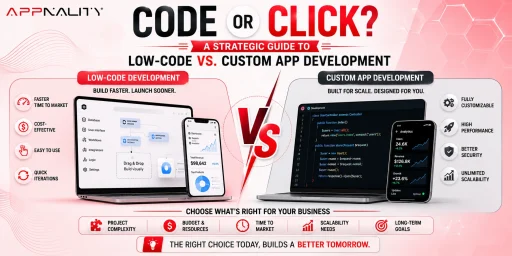
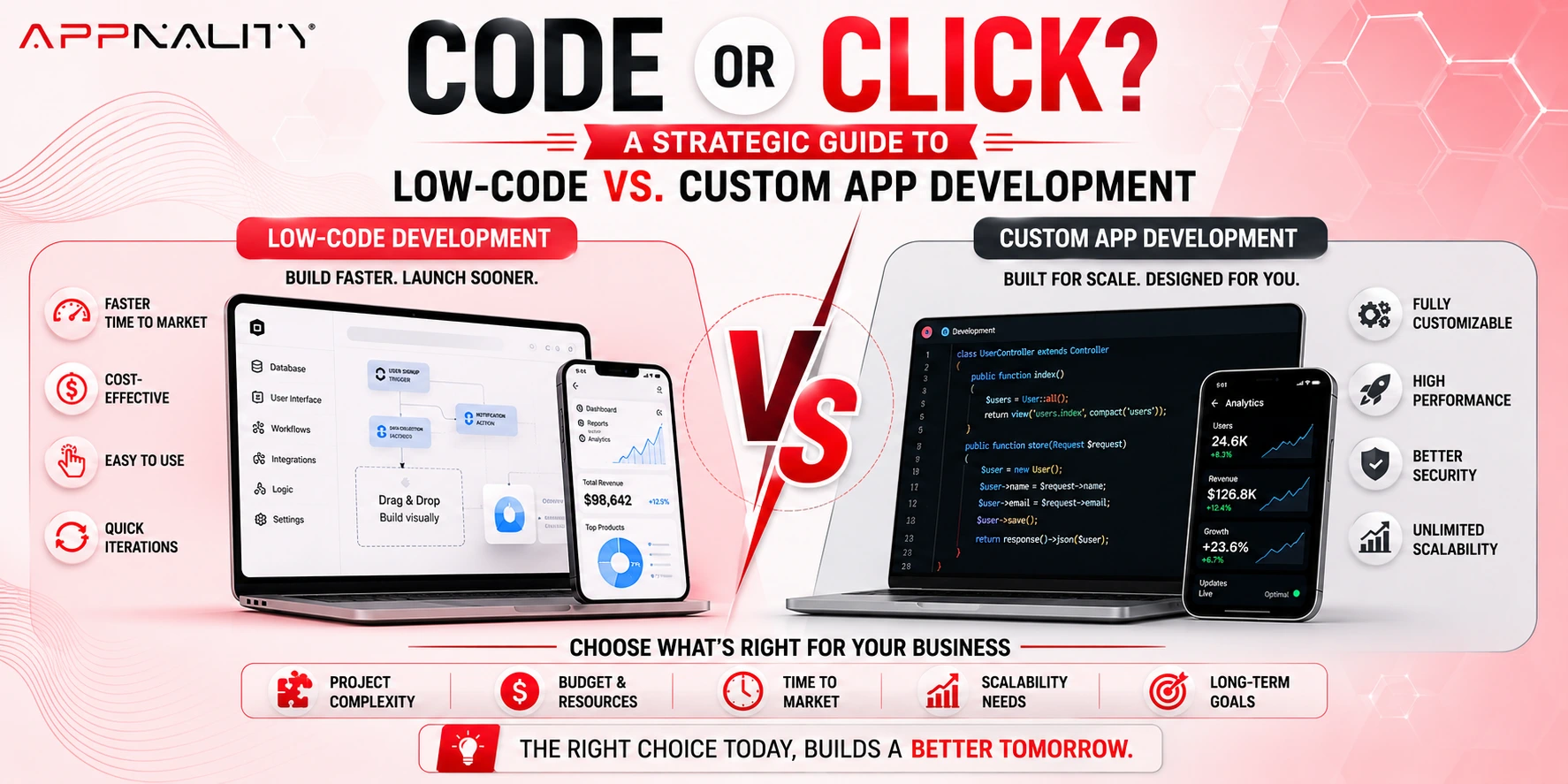

Low-code vs custom app development has become one of the most important technology decisions businesses face in today’s fast-moving digital economy. Companies are under constant pressure to launch software faster, automate operations, improve customer experiences, and adapt quickly to changing market demands.
This choice is not merely a technical preference; it is a business decision with long-term consequences for your budget, your scalability, and your competitive advantage. In our role as a development partner, we guide businesses through this complex decision every day. This guide is designed to provide a clear, technical, and strategic breakdown of the low-code vs custom app development debate.
What This Guide Will Help You Understand
Before we dive into the technical comparison, here is a look at what you will learn.
- Understand the fundamental distinction between the abstracted, model-driven approach of low-code and the ground-up, code-first approach of custom development.
- We will provide a detailed comparison across key technical and business criteria, including speed, scalability, security, and total cost of ownership.
- Learn the specific scenarios where low-code platforms excel and the critical situations where only custom development will suffice.
- Gain a clear understanding of the long-term trade-offs you make when choosing one path over the other, particularly concerning performance and data protection.
- Discover how a “best of both worlds” approach can leverage the strengths of both methodologies for a single, comprehensive business solution.
Defining the Two Paradigms
To make an informed decision, we must first establish a clear, technical understanding of each approach.
What Are Low-Code Development Platforms?
Low-code development platforms are visual environments that enable developers to build applications through graphical user interfaces, drag-and-drop components, and model-driven logic. Instead of writing thousands of lines of code, you assemble pre-built blocks of functionality.
The core principle is abstraction. The platform handles the underlying code generation, database connections, and infrastructure management, allowing the builder to focus on the business logic and user workflow. Platforms like OutSystems, Mendix, and Microsoft Power Apps are prominent examples in this space. They excel at accelerating the development of common application types, such as internal dashboards, data entry forms, and workflow automation tools.
What Is Custom App Development?
Custom app development is the traditional, code-first approach to building software. This involves a team of professional developers writing code from the ground up using programming languages like Python, Java, or JavaScript, and frameworks like React, Django, or .NET. Every feature, every line of logic, and every pixel of the user interface is crafted specifically for the project’s unique requirements.
This approach offers virtually limitless flexibility and control. It allows for the creation of highly unique user experiences, complex business logic, and deep integrations with other systems.
When you need to build a core product that represents your company’s intellectual property or an application with stringent performance and security requirements, custom app development is the definitive path. This method is the foundation of professional custom software development services.
Breaking Down the Core Technical Trade-Offs
The decision in the low-code vs custom app development debate hinges on a series of critical trade-offs. The right choice depends on which of these factors is most important for your specific project.
|
Factor |
Low-Code Development |
Custom App Development |
|
Speed to Market |
Extremely high. Can reduce development time by 50-90% for suitable applications. | Slower. Requires detailed planning, coding, and testing cycles. |
|
Customization & Flexibility |
Limited. You are constrained by the features and components provided by the platform. | Virtually limitless. Every part of the application can be customized to exact specifications. |
|
Scalability |
Varies. Often sufficient for internal or departmental use, but can face limitations or high costs at a massive user scale. | High. Architecture can be designed from the ground up for massive horizontal scaling and high-performance loads. |
|
Integration Capabilities |
Good for common services via pre-built connectors, but can be complex or impossible for legacy or proprietary systems. | Excellent. Custom APIs can be written to connect with any system, no matter how obscure. |
| Security & Compliance | Dependent on the platform provider. You are trusting their security posture and compliance certifications (e.g., SOC 2, HIPAA). | Full control. Security measures can be custom-built and audited to meet specific, stringent compliance requirements. |
| Total Cost of Ownership | Lower initial development cost, but can have high, recurring subscription fees and potential “vendor lock-in” costs. | Higher initial development cost, but no recurring licensing fees for the code itself. You own the IP completely. |
The Critical Question of Ownership and Intellectual Property (IP)
Beyond the technical trade-offs, there is a fundamental business question that every leader must consider in the low-code vs custom app development debate: Who truly owns the final product and its underlying intellectual property?
With custom app development, the answer is unequivocal. Your organization owns the source code, the design assets, the database schema, and every component of the application. It is a tangible asset on your company’s balance sheet. You have the freedom to take that code to any developer, modify it in any way, and host it anywhere you choose. This complete ownership is essential for companies whose core value is tied to their proprietary software.
With low-code development platforms, the ownership model is more complex. While you own the data and the specific business logic you have configured, you do not own the platform itself or the underlying code that runs your application.
Your app is inextricably tied to the provider. This creates a “vendor lock-in” risk. If the provider significantly raises prices, changes its terms of service, or goes out of business, your application is directly and immediately impacted.
For many businesses, this risk is acceptable for non-critical internal tools, but it is often an unacceptable risk for a core, customer-facing product.
Further, we always recommend security audits and penetration testing for custom applications handling sensitive data. For example, if you are working with healthcare applications, understanding requirements from healthcare mobile apps in California can provide valuable regulatory context.
When to Choose Low-Code Development Platforms
Low-code development platforms are not a replacement for all development, but they are an incredibly powerful tool for specific use cases. We see them deliver immense value in the following scenarios.
Internal Business Process Automation
If your goal is to digitize an internal paper-based process, such as employee onboarding, expense approvals, or IT support tickets, low-code is an ideal fit. The speed of development allows you to deliver a solution to your internal teams in weeks, not months.
Simple Data-Driven Applications
Low-code excels at creating straightforward CRUD (Create, Read, Update, Delete) applications. Think of a simple customer directory, a project management dashboard, or an inventory tracking app. These apps often have standard UI requirements that map well to pre-built components.
Building a Minimum Viable Product (MVP)
For some startups, a low-code platform can be a fast and cost-effective way to build an MVP to validate a business idea. It allows you to get a functional product in front of users quickly to test your core assumptions before investing in a full custom build. The principles of a lean start, as outlined in the standard mobile app development workflow, are perfectly served by this approach.
In essence, if your project’s primary driver is speed and the application’s functionality falls within the “80% use case,” one of the many low-code development platforms on the market is likely a strong contender.
When to Choose Custom App Development
While low-code is powerful, there are critical situations where it is not just suboptimal, but entirely unsuited for the task. In these cases, custom app development is the only viable path forward.
Building a Core, Customer-Facing Product
If the application is your primary source of revenue and competitive differentiation, you need the full control that custom development provides. Your app’s unique features and user experience are your intellectual property. Building this on a third-party platform is a significant strategic risk.
Applications with a Unique or Complex User Experience
Low-code platforms are inherently template-driven. If your app requires a highly bespoke, branded, or innovative user interface to stand out, custom development is necessary. You cannot create a truly novel game user experience, for example, with a drag-and-drop business form builder.
Systems Requiring High Performance and Scalability
For applications that need to serve millions of users with high transaction volumes, a custom-built architecture is essential. This allows your engineers to fine-tune every aspect of the system for performance and design a scalable infrastructure without the constraints or variable costs of a low-code platform.
For businesses requiring this level of sophistication, partnering with experienced mobile app development services ensures technical excellence from architecture through deployment.
Complex Integrations and Stringent Security
If your app needs to integrate with proprietary legacy systems or requires custom security protocols to meet specific compliance standards (beyond what the platform offers), you will need the flexibility of custom code.
This decision between low-code vs custom app development often comes down to a single question: Is this app a supporting utility, or is it the core of your business value proposition?
The Hybrid Approach for the Best of Both Worlds
It is important to note that the choice between low-code vs custom app development is not always a binary, either/or decision. A sophisticated and resource-efficient strategy we often employ is a hybrid approach.
This involves using low-code for parts of the system where speed is key, and functionality is standard, while using custom app development for the unique, mission-critical components.
A common example is building a complex, customer-facing mobile app using custom code to ensure a perfect user experience, while simultaneously using a low-code platform to quickly build the internal admin panel that your staff will use to manage the app’s content and users.
This frees up your expensive senior developers to focus on the revenue-generating front-end product, while your internal tools can be built much more quickly and cheaply. This is a common strategy for large-scale projects, where the skills required for enterprise app development services are focused on the most critical components.
Frequently Asked Questions
A Strategic Choice, Not a Technical One
In the final analysis, the debate over low-code vs custom app development is not about which methodology is technically superior, but which is the right strategic tool for the job at hand. Low-code platforms offer unprecedented speed and accessibility, while custom development, while more resource-intensive, provides the boundless control, performance, and flexibility.
The most important step is to assess your project’s goals. Are you optimizing for speed, or are you building a unique competitive advantage? Answering this question will illuminate the correct path. And remember that the right partner can help you evaluate these trade-offs and build a solution that perfectly aligns with your business’s vision. If you are ready to make that choice, our team at Appnality is here to provide the expertise you need.