
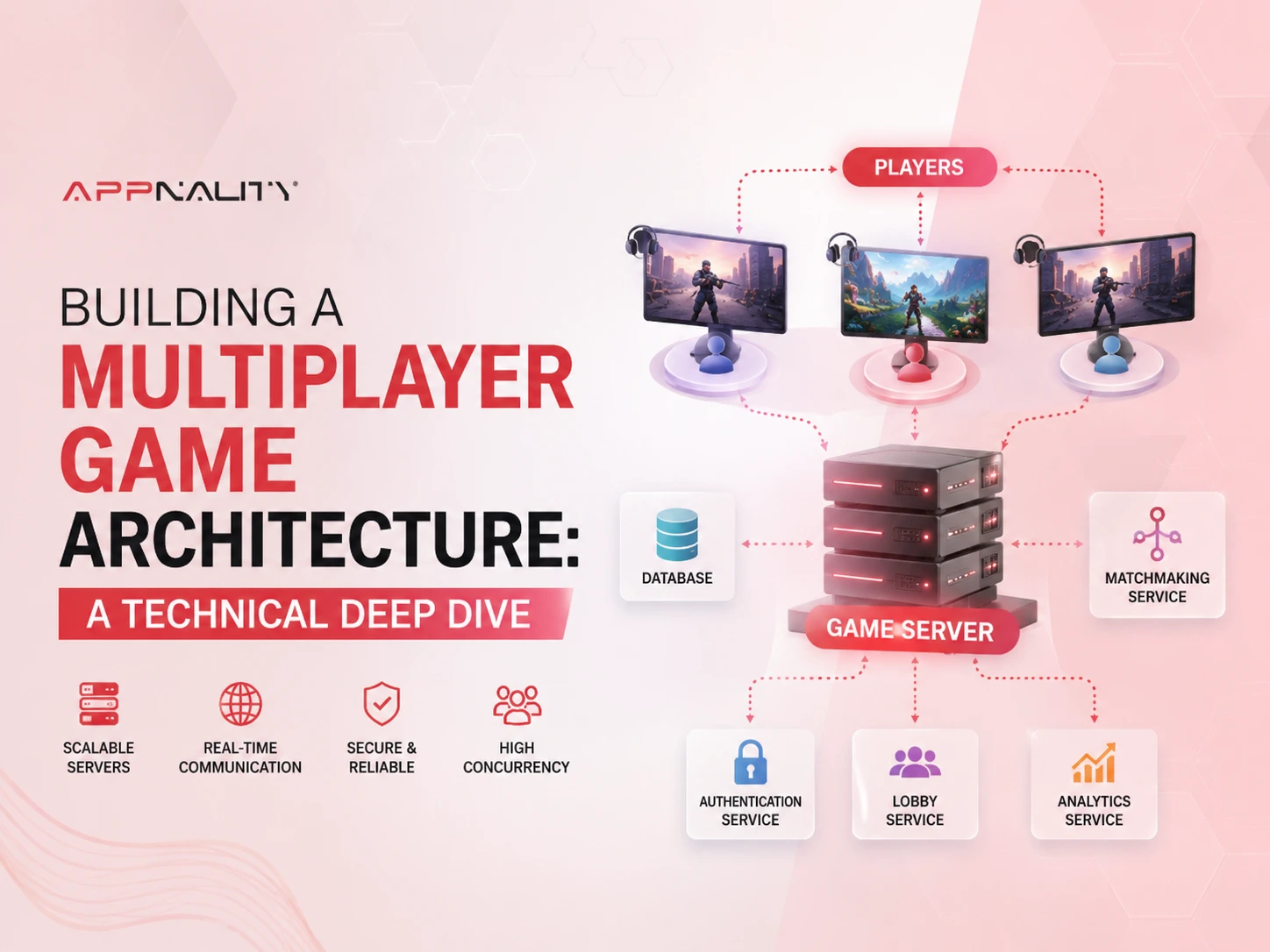

Multiplayer gaming represents the most technically challenging domain in mobile game development. The architecture decisions made during the early stages of multiplayer mobile game development fundamentally determine whether your game can scale, remain secure from cheaters, and deliver the smooth, lag-free experience players demand.
We have architected multiplayer systems for everything from turn-based puzzle games to real-time action titles, and the technical challenges differ dramatically based on game genre, player count, and synchronization requirements. This guide provides a technical overview of multiplayer game backend architecture, breaking down the core components that separate scalable multiplayer games from those that crumble under load.
Key Takeaways from This Guide
Before diving into technical architecture, here is what you will learn.
- Understand the fundamental server architectures used in modern multiplayer mobile game development, from authoritative servers to peer-to-peer models.
- Learn the essential technical components of multiplayer game backend systems, including game servers, matchmaking, and database architecture.
- Discover client-server communication patterns, state synchronization techniques, and latency compensation strategies that define player experience.
- Get actionable insights into building a multiplayer game backend development infrastructure that scales from hundreds to millions of concurrent players.
- Evaluate the engines, frameworks, and cloud platforms best suited for different types of multiplayer experiences.
The Three Core Multiplayer Architecture Models
Before exploring specific technical components, it is essential to understand the fundamental architectural patterns available. Each model presents different trade-offs in terms of latency, security, development complexity, and operational cost.
Client-Server Architecture with Authoritative Server
This is the gold standard for competitive multiplayer games and the dominant model in modern multiplayer mobile game development. In this architecture, a central server maintains the authoritative game state. All game logic executes on the server, and clients send input commands rather than direct state changes.
- Technical Advantages
The authoritative server model provides robust cheat prevention because clients cannot directly modify the game state. It ensures consistency since the server resolves all conflicts and maintains a single source of truth. Validation occurs server-side for all actions, preventing impossible moves or resource manipulation.
- Technical Challenges
Server costs scale with player count, as each game session requires dedicated server resources. Latency becomes a critical factor since every action requires a round-trip to the server. Infrastructure complexity increases significantly compared to single-player games.
This model is essential for PvP games, competitive esports titles, and any game where fairness and integrity are paramount. Building this infrastructure correctly requires deep expertise in multiplayer game backend development.
Peer-to-Peer Architecture
In peer-to-peer (P2P) models, clients communicate directly with each other, and one client typically acts as the “host” to maintain the game state. This eliminates the need for dedicated game servers.
- Technical Advantages
Operational costs are dramatically lower since no game servers are required. Latency can be lower for some players, particularly if they are geographically close. Development complexity is reduced compared to building a full server infrastructure.
- Technical Challenges
Security is fundamentally compromised because the host client has complete control over the game state, enabling easy cheating. Network topology can create inconsistent experiences where the host has an unfair advantage. Disconnection of the host player can terminate the entire game session.
P2P is suitable for cooperative games between friends, party games, and local multiplayer experiences where competitive integrity is less critical.
Hybrid Client-Server with Relay Servers
This model combines elements of both approaches. A lightweight relay server forwards packets between clients without executing game logic. This is common in real-time mobile games where latency is critical, but full authoritative servers would be too expensive.
- Technical Advantages
Lower server costs compared to fully authoritative models. Improved connectivity by solving NAT traversal issues that plague pure P2P. Moderate cheat resistance through server-side validation of critical actions only.
- Technical Challenges
Security is weaker than fully authoritative models. Implementation complexity is high, requiring sophisticated client-side prediction and reconciliation. Debugging is challenging due to the distributed nature of game logic.
Essential Components of Multiplayer Game Backend Infrastructure
Regardless of the architectural model chosen, all robust multiplayer game backend systems share several core technical components. Understanding these building blocks is fundamental to successful implementation.
Game Server Clusters
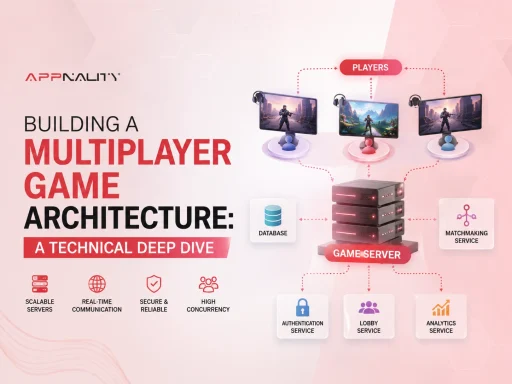
Game servers are the computational units that host individual game sessions. In authoritative architectures, these servers run the game loop, process player inputs, execute game logic, and broadcast state updates to connected clients.
Session isolation requires that each game instance run in a separate process or container to prevent one crashed game from affecting others. Resource allocation must be carefully managed, with CPU and memory limits per instance to prevent resource exhaustion. Horizontal scaling adds more server instances as player count increases, requiring orchestration systems like Kubernetes.
We typically implement game servers as stateless services that pull session data from a central database or cache. This allows any server to pick up a session if the original server fails. If you consider building these systems, leveraging website development services for admin dashboards and monitoring tools is essential for operational visibility.
Matchmaking and Lobby Systems
Matchmaking is the service responsible for grouping players into game sessions based on skill, latency, party composition, or other criteria. This is often the most algorithmically complex component of the backend.
Skill-based matchmaking (SBMR) uses player ratings like Elo or Glicko-2 to create balanced matches. Latency-based matching ensures players in the same geographic region are grouped to minimize ping. Party support allows groups of friends to queue together. Queue management handles wait times and backfill to keep matches starting quickly.
From a technical standpoint, matchmaking services must process thousands of queue updates per second, execute complex matching algorithms in real time, and integrate with game server allocation systems to spin up new servers when matches are found.
Database and State Persistence Architecture
Multiplayer games require robust data persistence for player profiles, inventory, progression, match history, and leaderboards. The database architecture must balance consistency, availability, and partition tolerance.
Relational databases like PostgreSQL or MySQL are used for transactional data like player accounts, purchases, and inventory. NoSQL databases such as MongoDB or DynamoDB handle unstructured data like match replays or chat logs. In-memory caches like Redis store frequently accessed data such as active sessions, leaderboards, and temporary state.
A common pattern is to use a write-through cache where all reads hit Redis for speed, but writes go to both Redis and the persistent database for durability. This architecture supports the high-throughput demands of multiplayer game backend development.
Authentication and Security Infrastructure
Security is non-negotiable in multiplayer games. The authentication system must verify player identity, prevent account takeover, and integrate with platform services like Game Center and Google Play Games.
Token-based authentication uses JWT (JSON Web Tokens) for stateless auth. Rate limiting prevents brute force attacks on login endpoints. Session management includes automatic timeout and device fingerprinting. Anti-cheat integration uses server-side validation of all critical actions.
For games with in-app purchases or tradable items, implementing server-side receipt validation and transaction logging is critical to prevent fraud. Understanding principles from common myths about hybrid app development can also inform cross-platform security strategies.
Network Protocol Design and Optimization
The protocol used for client-server communication is one of the most critical technical decisions in multiplayer mobile game development. The choice directly impacts latency, bandwidth consumption, and ultimately player experience.
Transport Layer Protocols
|
Protocol |
Best For |
Key Trade-off |
|
TCP |
Critical game data like inventory and match results |
Reliable, but adds latency |
|
UDP |
Real-time movement and action updates |
Faster but no delivery guarantees |
Most multiplayer games use a hybrid model: TCP for critical data and UDP for low-latency gameplay.
Serialization Formats
- JSON: Easy to read and debug, but larger payloads
- Protocol Buffers (Protobuf): Compact, fast, and schema-based
- MessagePack: Lightweight binary format with better performance than JSON
Binary formats like protobuf can reduce bandwidth usage by 50-70%, especially important for mobile games.
State Synchronization Strategies
|
Strategy |
Benefit |
Limitation |
|
Full State Updates |
Simple and fully consistent |
Very high bandwidth usage |
|
Delta Compression |
Sends only changed data |
More complex state tracking |
|
Interest Management |
Updates only nearby/relevant entities |
Requires advanced spatial systems |
Interest management is essential for large multiplayer games and is commonly built using quadtrees or grid-based partitioning.
Client-Side Prediction and Lag Compensation
Even with optimized protocols and server infrastructure, network latency is unavoidable. The human brain perceives delays above 100ms as noticeable lag. Since most mobile players have latencies of 50 to 150ms, techniques to hide this latency are essential.
Client-Side Prediction
The client instantly applies player actions locally instead of waiting for server confirmation, making gameplay feel responsive. When the authoritative server response arrives, the client compares states and corrects mismatches by replaying stored inputs.
Key components:
- Input buffering with sequence numbers
- Local prediction of player actions
- State reconciliation and replay logic
This is a core feature of advanced multiplayer game backend systems, especially in fast-paced games.
Server-Side Lag Compensation
To ensure fair hit detection, the server rewinds the game state based on a player’s latency, checks the shot in that historical state, and then returns to the current state.
Benefits:
- Shots that look accurate on the player’s screen register correctly
- Improves fairness in FPS and competitive multiplayer games
This requires historical state buffering and timestamp-based rewinding inside the multiplayer game backend architecture.
Scaling Multiplayer Infrastructure from Prototype to Millions of Players
A multiplayer game backend development strategy must account for growth from day one. Architectures that work for 1,000 concurrent users often collapse at 100,000 without a fundamental redesign.
Horizontal Scaling Patterns
|
Pattern |
Purpose |
|
Stateless Service Architecture |
Keeps services horizontally scalable by storing state in databases or caches instead of server memory. |
|
Load Balancing |
Distributes traffic across servers and uses sticky sessions for persistent real-time connections. |
|
Database Sharding |
Splits player data across multiple databases to handle millions of users efficiently. |
Cloud Platform Selection
Most modern multiplayer games run on cloud infrastructure rather than dedicated hardware. The three dominant platforms are AWS with services like GameLift for managed game server hosting, Google Cloud Platform offering Agones for Kubernetes-based game server orchestration, and Microsoft Azure with PlayFab providing a full backend-as-a-service platform.
Each platform has trade-offs in pricing, performance, and feature set. We typically recommend AWS or GCP if you have a dedicated DevOps team, and PlayFab for someone who wants a managed solution. For complex backend requirements, partnering with experts in iOS app development services can ensure platform-specific optimization for Apple’s ecosystem.
Technology Stack Recommendations by Game Type
The optimal technical stack varies significantly based on game genre and requirements.
Turn-Based Multiplayer (Asynchronous)
Backend framework using Node.js with Express or Python with FastAPI. Database utilizing PostgreSQL for relational data and Redis for caching. Hosting on serverless functions like AWS Lambda or Google Cloud Functions.
Turn-based games have relaxed real-time requirements, allowing for simpler architectures and lower costs. The primary technical focus is on robust state management and push notifications to alert players when it is their turn.
Real-Time Competitive Multiplayer (Synchronous)
Game server using Unity with Mirror networking or custom C++ servers. Protocol employing UDP with custom binary serialization. Matchmaking through custom service or AWS GameLift FlexMatch. Hosting via Kubernetes clusters on AWS or GCP.
These games demand the highest performance and lowest latency. Every architectural decision must prioritize reducing round-trip time and minimizing jitter.
Massively Multiplayer Online (MMO)
Distributed server clusters with spatial partitioning. Database architecture using sharded PostgreSQL with Redis caching. Message queue systems like RabbitMQ or Kafka for inter-server communication. CDN integration for asset delivery.
MMOs present the most complex technical challenges, often requiring years of development and specialized expertise in distributed systems. Resources like how AI trends are shaping mobile app development highlight how AI can assist in dynamic content generation and NPC behavior in these massive worlds.
Monitoring, Analytics, and Live Operations
Once deployed, multiplayer game backend systems require constant monitoring and optimization.
Critical Metrics to Track
Server performance includes CPU usage, memory consumption, and network throughput per instance. Player experience metrics cover average latency, packet loss rate, and connection success rate. Business metrics track concurrent users (CCU), daily active users (DAU), and match completion rate.
Implement real-time dashboards using tools like Grafana or Datadog to visualize these metrics. Set up alerts for anomalies like sudden latency spikes or server crashes.
A/B Testing Infrastructure
The ability to test changes with a subset of players before full rollout is critical. Implement feature flags that allow enabling new matchmaking algorithms, server configurations, or game balance changes for a percentage of users.
This requires a configuration management system that can update server behavior without code deployment.
Frequently Asked Questions
Building Multiplayer Systems That Scale and Perform
Architecting multiplayer mobile game development infrastructure is one of the most technically demanding challenges in game development. The decisions made during the design phase regarding server architecture, network protocols, state synchronization, and scalability patterns have profound and lasting impacts on player experience, operational costs, and competitive viability.
Success in this space needs strong expertise in distributed systems, networking, databases, and DevOps. The foundation you build early decides whether your game can scale from thousands to millions of players without major rewrites. If you’re building a multiplayer game, Appnality can help you design and scale the backend from day one through live operations.